
 Italiano
 Francais
 German
 Polski
 Hungarian



Voltage, Volts, and Current Draw: How They Affect the Performance of the Diavola Pro Pizza Oven v 3.0
- 04 Mar, 2026
- Insights
- 0 Comments
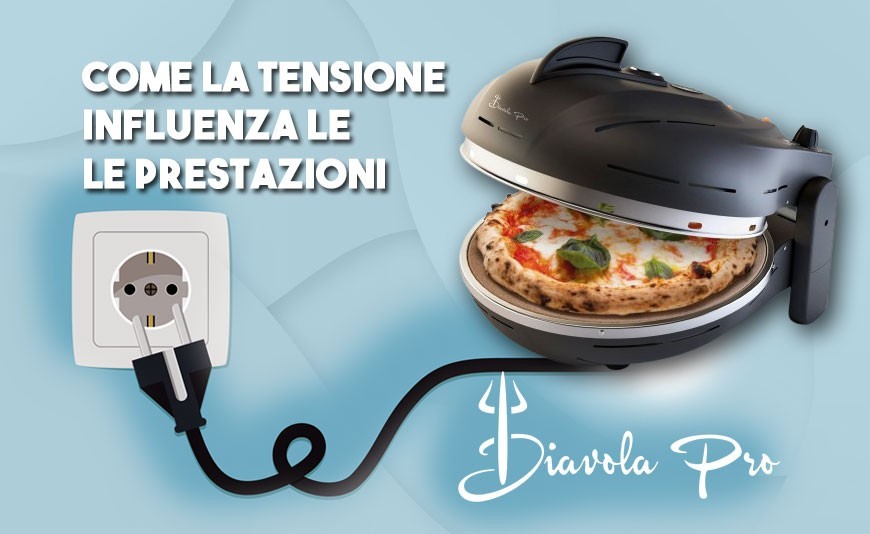
When discussing the performance of an electric oven, one of the most important – and often least understood – factors is electrical voltage (Volts).
In this article, we clarify:
- What voltage (Volts) really is
- Why the value changes when the oven is turned on
- How this affects power and performance
- How to correctly measure voltage at home
- What happens when multiple appliances are used at the same time
The practical reference is the Forno Pizza Diavola Pro v 3.0, but the concepts explained apply to all electric ovens on the market.
What is voltage (Volts) and why is it important?
Electrical voltage (Volts) is the “pressure” with which electrical energy is supplied to appliances.
In Italy, the nominal household voltage is:
230 Volts
This means the oven’s heating elements are designed to operate at their best at 230V.
What happens when the oven is off?
In the test performed:
- Voltage regulator set to 230V (nominal value of the heating elements)
- Oven turned off
- Other appliances turned off
The measured consumption is about 9 Watts (minimal consumption of electronic components).
The measured voltage is stable at around 230V.
What happens when we turn on the oven?
Lower heating element activated
- Voltage drops from 230V to about 226V
This happens because when a load draws current, a small voltage drop is generated in the electrical system.
Upper heating element also activated
- Voltage drops further to about 216V
- The oven operates at about 1800 Watts
Key point: the oven’s actual power depends on the real available voltage.
Why does the oven operate at 1800W at 216V and reach 2080W at 230V?
The power of an electric heating element is calculated using the formula:
P = V² / R
- P = Power (Watts)
- V = Voltage (Volts)
- R = Resistance (Ohms)
Since power depends on the square of the voltage, even a small variation in Volts significantly affects Watts.
Practical example:
- At 216V → about 1800W
- At 230V → about 2080W
A difference of 14 Volts generates nearly 300 additional Watts.
This means:
- Faster heating
- Greater temperature stability
- Higher cooking performance
Kit 3.1: the solution for household voltages below 230V
To support customers who experience household voltage lower than the nominal 230V, DiavolaPro has developed Kit 3.1 (view product).
The kit consists of:
- 1500W upper heating element (the oven currently mounts a 1400W one)
- 500W lower heating element (currently 600W)
This configuration allows, even in case of lower-than-normal voltage, to obtain a full 1400W on the upper heating element, improving performance and cooking quality in the upper chamber.
The reduction of the lower heating element does not compromise performance, because the deck temperature is mainly managed by the thermal inertia of the stone, which accumulates and releases heat consistently.
FAQ – Can I replace only the upper heating element with the 1500W one?
No.
The oven is certified for a maximum total power of 2000W. The sum of the two heating elements must not exceed this value.
Replacing only the upper heating element with the 1500W one while keeping the 600W lower element would raise the total power to 2100W, exceeding the oven’s certification limit.
For this reason, the correct upgrade is exclusively through the complete Kit 3.1, which keeps the oven within the intended technical and safety parameters.
What happens if we turn on other appliances?
During the test, a microwave was also turned on.
Result:
- Voltage dropped further below 216V
This demonstrates that:
- When the oven is on, voltage drops
- If we turn on other appliances, it drops further
- More simultaneous loads = greater voltage drop
When the oven is completely turned off, voltage returns to about 230V.
Why does voltage drop when we use appliances?
The main causes are:
- Home electrical system (cable length and cross-section)
- Quality of the grid connection
- Simultaneous loads
- Use of light-duty extension cords or power strips
Every electrical system has an internal resistance: when current flows, a voltage drop occurs. This is a normal phenomenon.
How do you correctly measure voltage at home?
Common mistake
Many users measure voltage at an “unloaded” outlet, meaning without any connected loads. In this case, they will almost always read 230V.
But this is not the real value during operation.
Correct method
Voltage must be measured:
At a loaded outlet, DURING oven operation.
Only then can you know the real available voltage while the oven is working.
Frequently asked questions
Does the oven work at 216V?
Yes. It operates normally, but with lower power compared to 230V.
If the voltage is lower, is the oven defective?
No. It depends on the electrical system and the loads active at that moment.
Why does the oven heat up faster in some homes?
Because the voltage under load is closer to 230V.
Does using multiple appliances at the same time damage the oven?
No, but it may temporarily reduce performance (fewer Watts available).
Conclusion
The nominal household voltage is 230V, but:
- When the oven is on → voltage drops
- With other appliances on → it drops further
- The oven’s real power depends on the actual voltage under load
To know how much power the oven is truly delivering, voltage must be measured while it is operating.
Understanding this mechanism allows you to correctly interpret performance and fully exploit the potential of the Forno Pizza Diavola Pro v 3.0.







0 Comments