
 Italiano
 Francais
 German
 Polski
 Hungarian



Home vs. Professional Pizza Ovens: Technical Differences No One Explains
- 06 Mar, 2026
- Insights
- 0 Comments
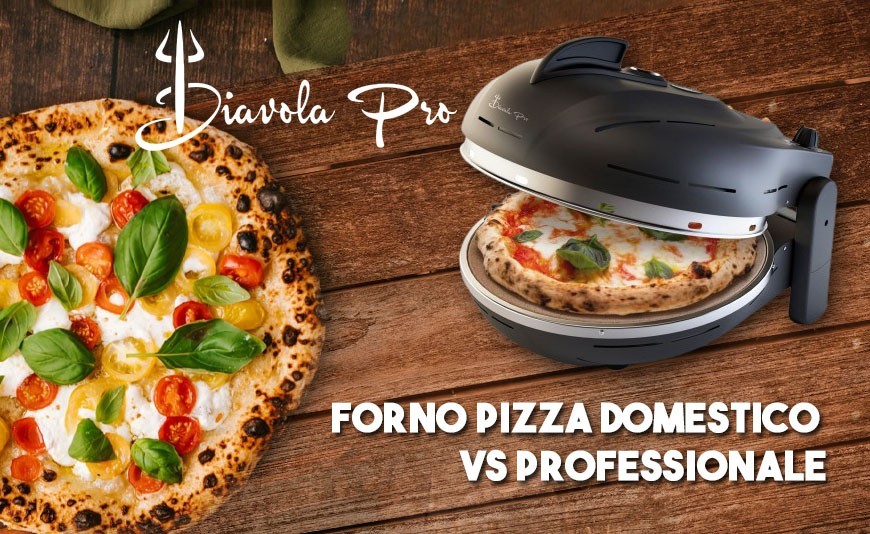
When talking about pizza ovens, the choice between a domestic model and a professional one can make the difference between a crispy, fragrant pizza like in a pizzeria and a mediocre cooking result. But what are the real technical differences between a domestic pizza oven and a professional pizza oven? In this article, we analyze the key parameters based on verified features, without marketing hype, to help you understand what really matters.
Temperature and power: the heart of cooking
Temperature is one of the most critical factors for a perfect pizza. In professional pizza ovens, temperatures often exceed 400-500°C, allowing for fast and uniform cooking. In contrast, traditional domestic pizza ovens operate between 250°C and 320°C, with slower heating.
- Professional: Reaches 400-500°C or more, with high power (often over 3500W for electric models) to maintain constant heat even with multiple loads.
- Domestic: Typically 250-300°C, with lower power and greater heat dispersion, leading to longer cooking times.
- Practical difference: In professional ovens, the pizza cooks in just a few minutes (1-2 min), while in domestic ones it can take 5-10 minutes, risking drying out the dough.
Materials and construction: durability and heat distribution
Materials define durability and thermal efficiency. Professional ovens use special materials to absorb and distribute heat evenly, while domestic ones are often simpler.
- Professional: Refractory stone or high-resistance stainless steel (e.g., Inox 310S), with designs that favor irradiation, convection, and thermal conduction.
- Domestic: Basic materials like common steel or aluminum, with lower thermal inertia, which can cause uneven cooking.
Size and portability: adaptability to use
Size affects everyday use. Professional ovens are designed for high volumes, while domestic ones fit limited spaces.
- Professional: Large dimensions, fixed position, weights often over 30 kg and difficult to move.
- Domestic: Compact (e.g., 30-40 cm footprint), portable, ideal for one pizza at a time in the kitchen or outdoors.
Consumption and energy efficiency
- Professional: They are very well insulated with very low heat dispersion, but often have high consumption due to size and installed power, which frequently reaches 3500 W or more.
- Domestic: Greater heat dispersion, with higher consumption to reach and maintain the desired temperature, offset however by the contained nominal power (typically 2000 W).
Cooking time and uniformity: concrete results
Speed and uniformity depend on the heating technology.
- Professional: Cooking in 1-2 minutes, with evenly distributed heat (irradiation from the dome, conduction from the base).
- Domestic: Longer cooking times (5+ minutes), with higher risks of burning on top or raw base.
Conclusion: how to bridge the gap between domestic and professional
Although professional pizza ovens offer superior performance for intensive use, some advanced domestic models reduce the gap with innovative technologies. A concrete example is the Diavola Pro v3.0, a domestic electric pizza oven that reaches temperatures up to 500°C in BOOST mode in 20-30 minutes, with 2000W power (1500W top, 500W bottom), 34 cm diameter refractory biscotto stone cooking surface, two independent thermostats, and compact dimensions (36.5 x 41 x 27 cm when closed). This allows cooking in 90-120 seconds while keeping the external temperature around 60°C thanks to advanced insulation, making it an ideal bridge between domestic and pro.
FAQ
- What is the main difference between a domestic and a professional pizza oven? Temperature: professional ovens exceed 400°C for fast cooking, domestic ones around 250-320°C.
- Which materials are better for a pizza oven? Refractory stone or stainless steel for thermal inertia and uniformity.
- How much does a professional pizza oven consume compared to a domestic one? Consumption is directly proportional to the product's nominal power.
- Is it possible to cook Neapolitan pizza in a domestic oven? Yes, with ovens that reach high temperatures and distribute heat evenly.







0 Comments