
 Italiano
 Francais
 German
 Polski
 Hungarian
 Ελληνικά



Electric Home Pizza Oven: Which One to Choose? Diavola Pro
- 07 Oct, 2026
- Insights
- 0 Comments
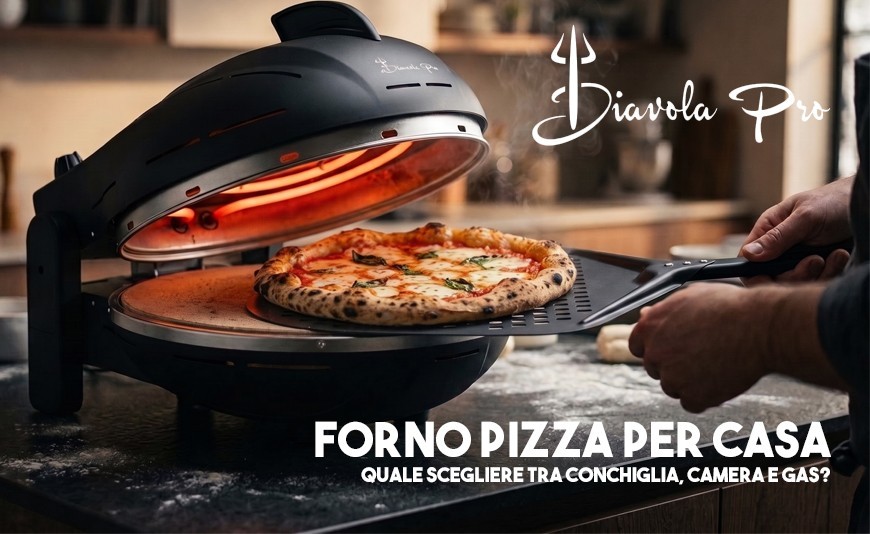
Best electric pizza oven for home: a guide to choosing between shell, chamber and gas models
Choosing the ideal pizza oven for the home environment requires a careful analysis of the appliance's thermal and structural characteristics. A professional countertop electric pizza oven must guarantee the actual achievement of 500°C to allow the cooking of true Neapolitan pizza in just 60-90 seconds, preserving the softness of the cornicione and preventing the dough from drying out. Discover the range and configurations available in the section dedicated to the Diavola Pro 3.0 pizza oven, designed with a patent and 100% Made in Italy engineering.
Why a traditional kitchen oven is not enough for true pizza
Almost all built-in domestic ovens have an insurmountable structural limit: a maximum temperature between 250°C and 275°C. This thermal delta compromises the chemical-physical reaction of the dough during cooking.
The 250°C limit and the biscuit-like pizza effect
When a hydrated dough ball is placed in the oven at 250°C, the cooking time inevitably rises to 8-12 minutes. During this prolonged period, the water contained in the dough evaporates completely before the protein structure has expanded and browned. The result is the classic dry, rigid and "biscuit-like" pizza, lacking melt-in-the-mouth softness and with completely dried-out dairy products.
The physics of 500°C: thermal thrust and Maillard reaction
In the high-performance pizza oven at 450°C-500°C, the water trapped in the air cells instantly turns into steam in the first 20 seconds (a phenomenon known as oven-spring). The cornicione rapidly puffs up, developing the typical canoe-like airiness, while the sugars and amino acids in the flour trigger the surface Maillard reaction, creating the characteristic spotting (leopard spot) without burning the internal crumb. To precisely calculate the proportions of water, salt and yeast based on this thermal thrust, you can use the professional pizza calculator.
Comparison between types of pizza oven: which system should you choose?
The market for pizza ovens dedicated to enthusiasts (pizza lovers and home pizzaioli) is divided into three main categories: outdoor gas ovens, square-chamber electric ovens and shell electric ovens.
- Outdoor gas ovens: They offer high power but come with strict constraints. They require mandatory outdoor use (garden or ventilated balcony), are subject to gusts of wind that extinguish or deflect the flame, require the bulky and dangerous handling of LPG cylinders, and create an asymmetrical heat zone that forces you to continually turn the pizza by hand with the peel.
- Chamber electric ovens (monobloc): They reproduce the geometry of professional pizzeria ovens. However, they often weigh more than 25-35 kg, require 45-60 minutes just for the initial preheating, take up considerable permanent space on kitchen counters, and involve current draw close to the contractual limit of 3 kW meters.
- High-performance shell electric ovens: They represent the ideal synthesis for the modern kitchen. They reach a real 500°C in just 15-20 minutes, weigh less than 10 kg, can be easily stored in any pantry, and can be used in total safety indoors on a normal worktop, without generating fumes or bad odors.
Decisive technical parameters before purchase
Not all compact ovens are the same. There are precise engineering elements that separate a toy appliance from a true professional countertop tool.
Thermal control: single thermostat vs independent double thermostat
Economy models have a single knob that controls both heating elements. This causes burning of the bottom of the pizza when the refractory stone accumulates excess heat while the top is still raw. A professional electric pizza oven must integrate two independent thermostats:
- Upper heating element (1500W top): Dedicated to the direct radiant thrust on the cornicione and to the even melting of the toppings.
- Lower heating element (500W base): Calibrated to keep the stone at the ideal temperature without carbonizing the base of the dough.
The geometry of the cooking chamber: the 7 cm safety gap
In traditional round ovens, the distance between the cooking surface and the upper coil is often less than 4-5 cm. When a high-hydration dough develops a pronounced cornicione, the dough inevitably touches the glowing heating element, burning instantly. The optimization to 7 cm of useful distance in the Diavola Pro v3.0 ensures the perfect space for maximum gas expansion without direct contact.
Thermal insulation and domestic safety: 500°C inside, 60°C outside
Working at very high temperatures inside the domestic kitchen requires rigorous construction standards. The internal chamber in 310S refractory stainless steel and the three-shell structure with an air gap and two 62 mm forced cooling fans keep the outer shell at a safe temperature of about 60°C, protecting the support surface and eliminating the risk of accidental burns.
The cooking surface: High-performance Biscotto or Refractory Stone?
The surface on which the dough rests determines the uniformity of cooking and the crispness of the pizza base. Depending on the desired style of pizza, it is essential to pair the right thermal surface:
- New High-Performance Biscotto: Made with an exclusive blend of natural clays fired in a kiln, it boasts low thermal conductivity and excellent inertia. It is the mandatory surface for true Neapolitan pizza at 450°C-500°C: it releases heat slowly, preventing any black burning on the bottom during 90 seconds of cooking. Available in the version Diavola Pro v3.0 with New Biscotto.
- Cordierite Stone: Characterized by rapid thermal conductivity, it is perfect for cooking at intermediate temperatures (320°C-380°C), making it ideal for thin Roman-style scrocchiarella pizza, pinsa, focaccia and crostoni. For these preparations, the optimal configuration is the Diavola Pro v3.0 with refractory stone.
- Biscotto di Sorrento: The artisanal volcanic stone of the Neapolitan tradition, suitable for those seeking the classic performance of Campanian wood-fired ovens. Those who already own the oven can integrate or alternate the stones by purchasing the specific replacement from the catalog Biscotto di Sorrento diameter 34 cm.
The evolution of cooking: turning the pizza without opening the lid
One of the historical problems of shell ovens is the need to open the dome halfway through cooking to rotate the pizza base, causing an immediate heat loss of up to 100°C and lengthening the time for the heating element to recover. The integration of the integrated pizza rotation system allows the refractory stone to be rotated directly from the outside with the oven sealed. The heat remains trapped in the chamber and the browning is perfectly radial and even at 360°.
For those who want the maximum technological equipment in a single purchase, the complete version Diavola Pro v3.0 with Biscotto and Rotating System combines total thermal control with patented mechanical rotation.
Frequently asked questions about the electric pizza oven for home
Does a 2000W pizza oven trip the home meter?
No. Normal Italian residential contracts provide for an committed power of 3 kW (with tolerance up to 3.3 kW). The oven draws 2000W at full load during the preheating phase (about 15-20 minutes). It is enough to avoid the simultaneous use of high-absorption appliances (such as washing machines or dishwashers) during the cooking session.
Can I also use the pizza oven inside the kitchen?
Yes, unlike wood-fired or gas models, the electric oven does not produce carbon monoxide or combustion fumes. Thanks to the insulation system and the cooling fans, it can be placed on any table or kitchen counter in total safety, powered by a standard 230V Schuko socket.
Which accessories are essential to start?
To place the pizza in the oven precisely without deforming the risen dough ball, it is recommended to use an perforated aluminum pizza peel that releases excess dusting flour before baking, together with a steel-bristle brush for maintenance and hot cleaning of the biscotto through natural pyrolysis.





0 Comments