
 Italiano
 Francais
 German
 Polski
 Hungarian
 Ελληνικά



How Much Electricity Does a 2000W Electric Pizza Oven Use? Real Costs on Your Bill
- 16 Oct, 2026
- Insights
- 0 Comments
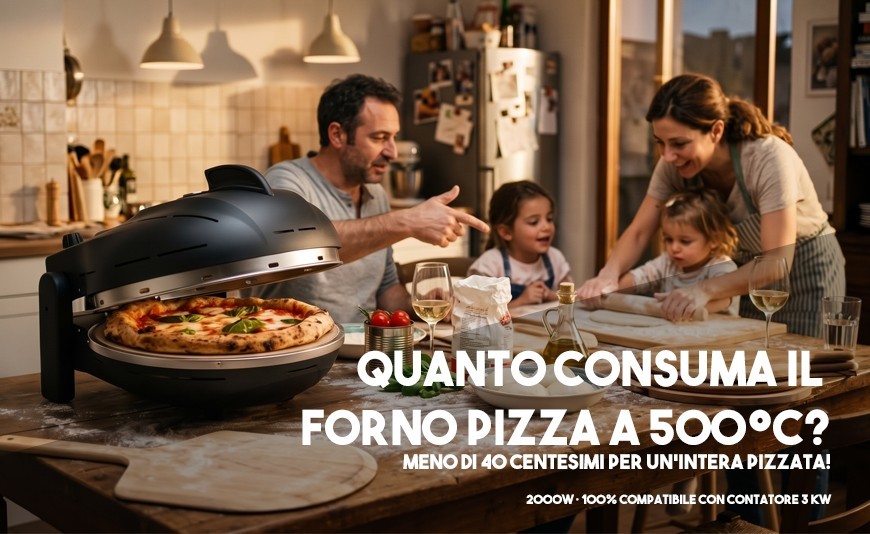
How Much Electricity Does a 2000W Electric Pizza Oven Use? Real Electricity Costs for a Pizza Night
One of the most frequently asked questions among pizza-making enthusiasts concerns the energy consumption required to reach high temperatures: how much electricity does a 2000W pizza oven use when it can reach 500°C? Despite the high thermal power required to cook a pizza in just 60–90 seconds, the overall efficiency of a compact, insulated appliance far exceeds that of a standard built-in oven. With carefully engineered thermal management, such as that featured in the Diavola Pro 3.0 pizza oven, a complete cooking session for the whole family adds just a few cents to your electricity bill.
Rated Power vs. Actual Consumption: How 2000W Works
An appliance's rated power indicates its maximum instantaneous power draw when all components are operating at full capacity. In the case of a professional clamshell-style pizza oven with dual temperature control, the total power of 2000 watts is distributed as follows:
- Upper heating element (1500W top heat): Designed with an extended linear heating element to provide even direct heat to the crust and toppings.
- Lower heating element (500W baking stone): Calibrated to transfer consistent heat to the refractory stone without causing thermal shock or burning the pizza base.
This does not mean that the oven continuously draws 2000 watts for every hour it is switched on. Once the operating temperature of 450°C–500°C is reached, the two independent thermostats regulate power delivery: the heating elements switch on and off in cycles to compensate only for heat loss, reducing average power consumption to approximately 65–70% of the rated power.
Cost Breakdown: How Much Does a Pizza Night at Home Really Cost?
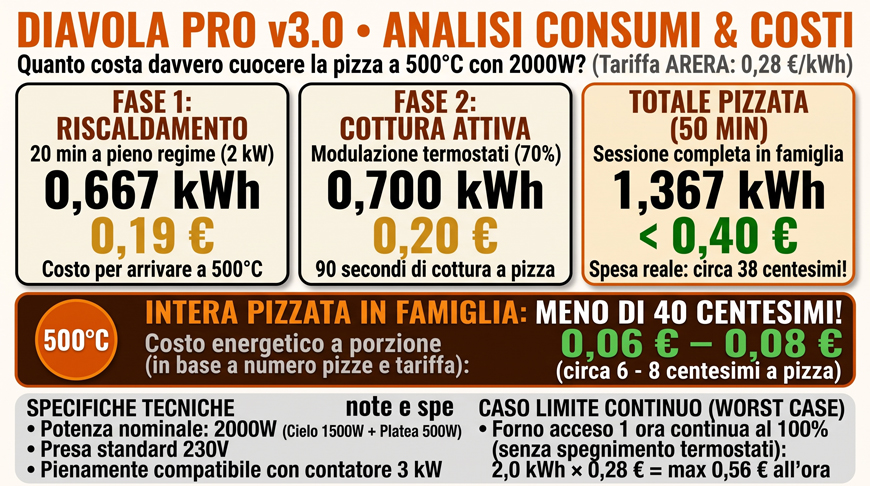
To calculate the actual cost of a typical homemade pizza night involving six pizzas, let's assume an indicative average electricity price of €0.28 per kWh (including the energy component, system charges and taxes):
1. Preheating Phase (15–20 Minutes)
During the initial heat-up from room temperature to 500°C, both heating elements operate at full power (2.0 kW). Over 20 minutes, energy consumption is approximately 0.67 kWh, equivalent to an actual cost of around €0.19.
2. Active Cooking Phase (6 Neapolitan-Style Pizzas)
With the Diavola Pro v3.0, each pizza cooks in just 60–90 seconds. Keeping the oven switched on for a further 25–30 minutes to allow for dough stretching, loading and rotating the pizzas, average energy consumption for maintaining the temperature is approximately 0.70 kWh, costing around €0.20.
Total energy consumption for the entire session (switching on, preheating and cooking six pizzas) is approximately 1.37 kWh, for a total cost of just €0.39 (less than €0.07 per pizza).
Energy Consumption Comparison: Diavola Pro v3.0 vs. a Traditional Built-In Oven
Contrary to what you might expect, a conventional oven uses considerably more electricity, despite being unable to exceed 250°C:
- Traditional built-in oven (2500W): Requires 30–40 minutes of preheating to heat a 60–70-litre cavity and takes between 10 and 14 minutes to cook each pizza or tray. Cooking six pizzas in succession means keeping the oven on for more than an hour and a half, consuming approximately 3.38 kWh (costing over €0.95), often resulting in a dry, overbaked pizza.
- Diavola Pro v3.0 electric pizza oven (2000W): Features a compact, low-dome cooking chamber with just 7 cm between the heating element and the stone, rapid preheating in 15–20 minutes and cooking times of just 90 seconds. Lower heat loss means less energy consumption and results comparable to those of an authentic Neapolitan pizzeria. To adjust your dough quantities to this level of heat without wasting energy, consult the professional pizza calculator.
Can Your Home's 3 kW Electricity Meter Handle a 2000W Pizza Oven?
Yes, operation is fully compatible with standard Italian residential electricity contracts rated at 3.0 kW. Modern electronic meters allow continuous power draw up to 10% above the contracted power (3.3 kW indefinitely), with temporary peaks of up to 4.0 kW for periods of up to 180 minutes.
With a power draw of 2000W at 230V, more than 1000–1300 watts remain available for your home's background electricity consumption (refrigerator, LED lighting, Wi-Fi router and TV). The only practical precaution is to avoid switching on other high-power heating appliances, such as a washing machine, water heater or dishwasher, at the same time during preheating.
Thermal Insulation That Reduces Energy Consumption: 500°C Inside, 60°C Outside
The main factor behind the Diavola Pro's low energy consumption is its Italian-engineered design, featuring a three-shell structure with a 310S stainless steel chamber and two 62 mm rear cooling fans. This architecture provides two key benefits:
- Heat retention: The thermal energy generated by the 1500W upper heating element remains concentrated on the refractory cooking surface rather than escaping into the surrounding environment, reducing how often the thermostat needs to activate the heating element.
- Reduced external heat and safer countertop use: While the internal chamber reaches 500°C, the external surface stays at around 60°C, allowing the oven to be used on any kitchen worktop with complete safety.
How to Maximise Your Pizza Night's Energy Efficiency
To optimise cooking times and minimise energy waste, follow these practical tips:
- Choose the right cooking surface: If you love authentic Neapolitan pizza cooked at very high temperatures, the oven with the high-performance New Biscotto stone provides gradual heat release, helping preserve the heat accumulated between pizzas. If you prefer Roman-style pizza or extra-crispy pizza (scrocchiarella) at 360°C, the version with a cordierite refractory stone reaches the optimal temperature even faster.
- Avoid lifting the lid unnecessarily: Every time you open the clamshell lid, it can release as much as 80–100°C of heat, forcing the upper heating element to operate at full power to recover the lost temperature. Installing the integrated pizza rotation system allows you to rotate the pizza while keeping the oven fully closed, minimising heat loss and reducing total operating time.
- Load the pizza accurately: Using a perforated anodised aluminium pizza peel prevents excess raw flour from falling onto the stone, where it could burn and produce smoke, keeping the cooking chamber clean and efficient throughout the session.
Frequently Asked Questions About Pizza Oven Energy Consumption
Does an electric pizza oven use more electricity than an air fryer or an induction hob?
No. A typical air fryer draws between 1800W and 2200W and requires cooking cycles of 20–35 minutes. An electric pizza oven draws a similar peak power but cooks an entire pizza in less than 90 seconds, making it one of the most energy-efficient cooking appliances in terms of energy used per serving.
Do I need an industrial connection or a special 16A socket?
The Diavola Pro v3.0 operates using a standard 230V, 16A domestic Schuko socket. No industrial three-phase supply or dedicated modifications to the main electrical panel are required.
Can I use an extension lead to cook outdoors on a balcony or in the garden?
Yes, provided you use a certified extension lead with a cable cross-section of at least 3 × 1.5 mm² (preferably 3 × 2.5 mm²), ideally fitted with a 16A socket, and fully unwound to prevent the cable from overheating and minimise voltage drops while supplying 2000W.






0 Comments