
 Italiano
 Francais
 German
 Polski
 Hungarian
 Ελληνικά



Neapolitan Pizza Oven Temperature: What Are the Required Degrees and Cooking Times?
- 20 Oct, 2026
- Insights
- 0 Comments
Neapolitan Pizza Oven Temperature: Ideal Degrees and Cooking Times in 90 Seconds
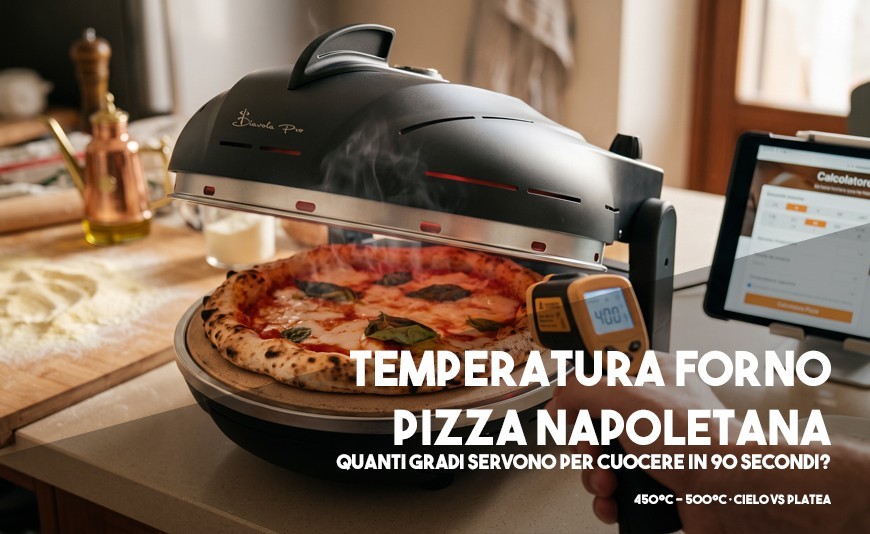
The correct Neapolitan pizza oven temperature is the primary thermodynamic factor that distinguishes an authentic pizza from a dry or rubbery disc of dough. To achieve the characteristic texture of a true Neapolitan pizza — a puffy, airy and soft crust, a base free from burnt spots, and melted cheese without fat separation — the cooking chamber must operate between 450°C and 500°C, with cooking times strictly between 60 and 90 seconds. Achieving this balance at home requires equipment designed for professional countertop use, such as the Diavola Pro 3.0 pizza oven, which can deliver a stable temperature of 500°C thanks to its entirely Italian-developed thermal engineering.
The Physics of 500°C: What Happens to Pizza Dough Above 450°C
When a hydrated dough ball enters an environment at 480°C–500°C, its structure transforms almost instantly, following precise physical principles:
- Instant oven spring and open crumb development: During the first 20–30 seconds after the pizza enters the oven, the water trapped within the gluten network evaporates rapidly. The resulting internal pressure expands the air pockets formed during fermentation, pushing the crust upwards before the outer layer solidifies.
- Preservation of internal moisture: With an ultra-fast cooking time of 90 seconds, the dough retains much of its internal moisture (approximately 60–65% residual moisture in the crumb). By contrast, conventional ovens operating at 250°C require 10–15 minutes, and this extended cooking time dehydrates the dough, producing the familiar hard, biscuit-like texture.
- Maillard reaction and Neapolitan leopard spotting: At 450°C–480°C, surface sugars and amino acids brown rapidly, creating the characteristic leopard-spotted pattern, with aromatic, darkened bubbles surrounded by an unburnt crust.
To calculate the precise hydration level and yeast quantities needed for the intense heat of a 500°C oven, it is advisable to set the correct parameters using the professional pizza calculator.
Upper Heating Element vs. Baking Surface Temperature: Finding the Perfect Balance
One of the most common mistakes when using an electric pizza oven is treating temperature as a single value. Neapolitan pizza requires two distinct heat sources to work together at different power levels:
Upper Heating Element (Radiant Heat at 480°C–500°C)
The upper part of the cooking chamber requires maximum thermal output. An enhanced 1500W upper heating element, positioned just 7 cm from the pizza surface, delivers continuous, powerful radiant heat. This is essential for cooking the crust and browning the toppings without drying out the fior di latte mozzarella or tomato sauce.
Baking Surface (Conductive Heat at 420°C–450°C)
The baking surface transfers heat directly to the pizza base through contact. At temperatures above 400°C, a standard cordierite refractory stone transfers heat too quickly, burning the base before the toppings are fully cooked. For this reason, the baking surface temperature must be managed by an independent lower heating element, such as the 500W element in the Diavola Pro v3.0, and paired with a suitable refractory clay baking surface.
Choosing the Right Baking Surface: Why Biscotto Is Essential at 480°C
The thermal conductivity of the material determines the success of high-temperature pizza baking. Not all refractory stones are suitable for operation at 500°C:
- Cordierite Stone: This material has high thermal conductivity. It is suitable for baking at temperatures of up to 360°C–380°C, such as for tray-baked pizza or Roman-style extra-crispy pizza (scrocchiarella). At temperatures above 420°C, it can irreversibly burn the base of a Neapolitan pizza in less than 40 seconds.
- Traditional Sorrento Biscotto: Made from volcanic clays from Campania, Italy, it has high porosity, ensuring slow and consistent heat release. It is the traditional choice for authentic Neapolitan pizza and is available as an upgrade in the form of the 34 cm Sorrento Biscotto.
- High-Performance New Biscotto: Designed to maximise thermal performance in electric ovens with low domes, it allows pizzas to be baked with a baking-surface temperature of 420°C–450°C without the risk of charring the flour. The result is a dry, non-bitter and perfectly crisp base. It comes as standard with the Diavola Pro v3.0 with Biscotto and Rotating System.
Summary Table: Pizza Styles, Temperatures and Cooking Times
Each pizza style requires a specific combination of upper heating element temperature and baking-surface temperature:
- Traditional Authentic Neapolitan Pizza: Upper heat 480°C–500°C | Baking surface (Biscotto) 420°C–440°C | Cooking time: 60–90 seconds.
- Contemporary Neapolitan Pizza (70–75% Hydration Canotto Style): Upper heat 470°C–490°C (BOOST mode) | Baking surface 410°C–430°C | Cooking time: 80–100 seconds.
- Roman-Style Extra-Crispy or Thin Pizza: Upper heat 350°C–370°C | Baking surface (Cordierite) 330°C–350°C | Cooking time: 2.5–3 minutes.
- Tray-Baked Pizza / Focaccia: Upper heat 280°C–300°C | Baking surface 300°C–320°C | Cooking time: 6–8 minutes.
BOOST Mode and Temperature Recovery Between Pizzas
When baking several pizzas in succession during an evening with friends or family, every time the oven lid opens, some of the hot air immediately escapes. To keep the oven ready for each pizza:
- Activate BOOST mode: This mode keeps the heating elements continuously powered during the loading phase, preventing the thermostat from switching them off precisely when maximum radiant heat is needed to cook the crust.
- Monitor the baking stone temperature: Before loading the next pizza, wait 60–90 seconds with the lid closed to allow the Biscotto stone to recover the heat absorbed from the previous pizza.
- Rotate the pizza with the oven closed: To avoid temperature fluctuations caused by opening the lid halfway through cooking, the pizza rotation system allows you to rotate the stone from the outside, achieving even browning through 360° without losing the 500°C heat accumulated inside the dome.
Frequently Asked Questions About Neapolitan Pizza Oven Temperature
How can I accurately measure the temperature of a refractory stone?
The most accurate method is to use an infrared laser thermometer with a temperature range of at least 550°C. Aim it directly at the centre of the refractory Biscotto stone before placing the pizza dough on it. For authentic Neapolitan pizza, the reading should be between 430°C and 460°C.
What should I do if the dusting flour burns on the hot stone?
At 480°C, white type 00 flour burns almost instantly, turning into black smoke and bitter ash. It is essential to stretch the dough balls using remilled durum wheat semolina and remove any excess before baking with a perforated pizza peel. Keep the refractory surface clean between pizzas using a brush with steel bristles.
How long does it take to preheat the oven to 500°C?
Thanks to its three-layer 310S stainless steel insulation and optimised heating elements with a combined power output of 2000W, the Diavola Pro v3.0 reaches its operating temperature of 480°C–500°C in approximately 20 minutes, significantly reducing energy consumption compared with professional chamber ovens that require more than an hour to heat up.






0 Comments