
 Italiano
 Francais
 German
 Polski
 Hungarian
 Ελληνικά


Pizza Burnt on the Bottom or Raw on Top: How to Adjust the Thermostats
- 29 Oct, 2026
- Insights
- 0 Comments
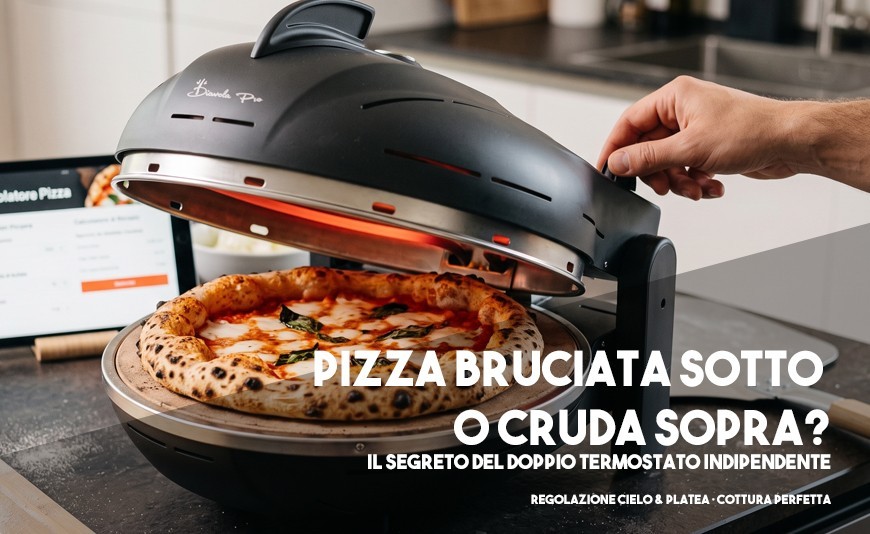
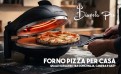
One of the most frustrating issues for those who bake pizza at home is thermal imbalance: ending up with a pizza that is burnt on the bottom but raw on top—or vice versa, with a pale crust and a charred base—is a common experience for many home enthusiasts. This cooking flaw almost never stems from the dough itself, but rather from the inability to independently regulate heat sources. To achieve results on par with a professional pizzeria, it is essential to use the Diavola Pro 3.0 pizza oven. Featuring dual, independent thermostats—a patented, Italian-made technical solution—it allows for separate control of the oven’s dome and its refractory stone cooking surface.
The three main causes of uneven baking
Two distinct methods of heat transfer are involved in pizza thermodynamics: conduction (direct transfer from the stone to the base of the pizza) and radiation (thermal waves emitted by the upper heating element towards the crust and toppings). When these two forces are not perfectly synchronized, baking fails for three specific reasons:
- Thermal imbalance of the stone: In inexpensive clamshell ovens equipped with a single general thermostat, the lower heating element continuously heats the refractory stone. The stone exceeds the critical threshold of 420°C–440°C while the air in the dome has not yet reached sufficient radiant power. The base of the pizza chars within the first 40 seconds, leaving the mozzarella and crust translucent or raw.
- Excess raw dusting flour: Stretching dough balls using too much white type 0 or 00 flour creates a dusty insulating layer beneath the dough disc. At high temperatures, the raw flour burns instantly, releasing a bitter taste and smoke and creating the optical illusion that the base is cooked before the heat has penetrated the dough.
- Excess moisture and thermal shock from ingredients: Using dairy products straight from the refrigerator or not properly drained of whey suddenly lowers the surface temperature of the dough disc. Heat from the upper element is absorbed by the evaporation of water from the cheese instead of browning the crust, extending the top-baking time while the base on the baking stone continues to cook relentlessly.
The technical advantage of two independent thermostats
The architecture of the dual-control electric oven eliminates dependence on a single thermostat circuit, assigning a specific, calibrated power level to each zone:
- Upper heating element (1500W): Dedicated exclusively to very high-intensity radiant heat. It caramelizes the sugars in the crust (the Maillard reaction), creates leopard spotting and melts the toppings evenly without boiling the tomato sauce.
- Lower heating element (500W): Calibrated for targeted power consumption to maintain the temperature of the refractory stone without causing destructive temperature spikes on the bottom of the dough ball.
Thanks to this separation, the upper heating element can be kept on continuously (also using BOOST mode) to reach 480°C–500°C at the crust, while the lower control knob is turned down or temporarily switched off once the stone has stored the correct amount of thermal energy. To calculate the ideal ingredient quantities, hydration and proofing times to pair with these settings, you can refer to the professional pizza calculator.
Practical guide: how to set the thermostats for each pizza style
Depending on hydration and pizza style, the balance between upper and lower heat varies considerably:
1. Traditional and Contemporary Authentic Neapolitan Pizza
Neapolitan pizza requires the greatest thermal asymmetry: an extremely hot upper element to brown the pizza in 60–90 seconds and a baking surface that releases heat slowly and steadily to avoid burning the base.
Neapolitan pizza requires the greatest thermal asymmetry: an extremely hot upper element to brown the pizza in 60–90 seconds and a baking surface that releases heat slowly and steadily to avoid burning the base.
- Upper thermostat (top heat): Set to 480°C–500°C (maximum power / BOOST) during baking.
- Lower thermostat (baking surface): Set to 400°C–440°C; it can optionally be switched off during baking, depending on your dough.
- Recommended baking surface: It is essential to use a low-conductivity surface such as the oven with high-performance New Biscotto stone, which does not transfer aggressive heat spikes to the dough.
2. Roman Scrocchiarella Pizza and Thin-Crust Pizzas
This style requires the dough to dry out gradually and the base to become crisp, while avoiding intense bursts of heat on the crust that would dry out the surface too quickly.
- Upper thermostat (top heat): 340°C–360°C.
- Lower thermostat (baking surface): 360°C–380°C.
- Recommended baking surface: The configuration with a cordierite refractory stone ensures the rapid transfer of heat needed to give the base its characteristic crispness.
3. Tray Pizza and High-Hydration Focaccia
When baking in a metal tray, the base needs a steady boost of heat from below to conduct heat through the metal, while the dome must support the rise without burning the toppings on the surface.
- Upper thermostat (top heat): 260°C–280°C.
- Lower thermostat (baking surface): 300°C–320°C.
The importance of chamber height: the 7 cm rule
Even with perfectly adjusted thermostats, a common problem with traditional clamshell ovens is that the upper heating element is too close to the dough. When a dough ball with 70% hydration develops a large air pocket, the crust can touch the red-hot heating element directly and char instantly.
The Diavola Pro v3.0 baking chamber is engineered with a precise 7 cm clearance between the stone and the upper heating element. This space allows the crust to expand fully in height (oven spring), exposing it only to infrared radiation and eliminating the risk of physical contact and localized burning.
What to do if you notice an imbalance halfway through baking: three quick fixes
If you notice during baking that one side is cooking too quickly, you can intervene using these corrective techniques:
- Base cooking too quickly: Slide the tip of the pizza peel under the pizza and lift it 1–2 cm off the stone for the final 15 seconds, finishing the browning on top using only the radiant heat from the upper element.
- Surface browning before the base: Immediately turn the upper thermostat down to 400°C to stop the direct incandescence of the upper heating element, and let the heat stored in the refractory stone act through conduction.
- Uneven browning: Do not open the clamshell dome, which can release up to 100°C of internal temperature. The version equipped with an integrated pizza rotation system allows you to rotate the pizza up to 270° while keeping the chamber closed, compensating for any unevenness in radiant heat.
Frequently asked questions about adjusting a pizza oven
How can I clean the stone if the bottom of the pizza has burned and left black residue?
Never wet the stone with water or cleaning products. Heat the oven to 450°C–500°C with the dome closed for 15 minutes: the pyrolysis process will reduce carbon residue to a very fine ash, which you can remove once the stone has cooled using a steel-bristle brush.
Why doesn't pizza burn underneath at 450°C on the clay Biscotto stone, while it does on cordierite?
The New Biscotto and the Biscotto di Sorrento have a specific microporosity that releases stored heat very slowly through contact. Cordierite, by contrast, has high thermal conductivity and transfers heat aggressively and immediately, making it suitable for baking at lower temperatures, below 380°C.
Which pizza peel should I use to avoid bringing excess flour onto the refractory stone?
The essential accessory for preventing the base from burning because of flour dust is a perforated aluminium pizza peel. Its precisely sized slots allow excess flour from stretching to fall away before the pizza goes into the oven, keeping the refractory surface clean and preventing bitter smoke.



0 Comments